USA Healthcare versus Ecuador Healthcare
First thing’s first where in the heck has Texas Annie been? The answer is simple very busy with life and a few issues dealing with US healthcare which is not for the faint of heart. The saga begins as follows, but you can decide for yourself.
Let me clarify that this information is based on our personal experience. So let the story begin. In February, my husband returned to Texas to attend a writing conference in Austin while I stayed in Ecuador. Upon arrival in Austin, his leg began to swell. Being a Registered Nurse for 34 years the first thing I asked him to do was measure his calf. Glad I packed a measuring tape in his bag to be used to measure possible items he might want to bring back. It turns out the calf of one leg was an inch larger than the other leg. The next day the swelling in his calf continued. I encouraged him to at least go to a neighborhood healthcare center to have his leg evaluated. Well, you know how a husband can be, but finally, he went. They immediately sent him to a local hospital emergency room where for admission with a diagnosis of deep vein thrombosis (DVT). My first thought was “thank heavens he is in the US under a great medical system.” I based this on my experience as a Registered Nurse, but later I would recant these words. I now entered the frantic stage and am so worried because DVT is dangerous! The clot could easily break off and head to his lungs and resulted in a pulmonary embolism which might be fatal.
Finally, my husband left in the middle of one of the conference’s presentations and headed to the small neighborhood health care center and never thought he would be spending the night in the hospital. So he did not have his telephone charger with him which further complicated communication between us. Remember I am still in Ecuador. Our conversations were short since his telephone battery was running low. I called the hospital directly and learned he now was admitted to a room; I was able to call him. I could call him directly since we have an Ooma telephone that allows us to make calls over the internet without additional charges. But oh what a nail-biting stressful night it turned out to be.
None of the doctors that examined him was a vascular specialist nor did they call in a vascular consult. The doctors did administer IV medication and other tests, but I have still yet to find out what medication he received. The medical records department was closed when he was released but agreed to send his records to his primary physician in Arlington. However, a time frame to send these documents was a mystery and not included in the promise. He was released the next day with a prescription for Eliquist (Apixban) an oral prescription medication to treat blood clots and DVT. Upon release from the hospital, he obtained the prescription to fill and was warned not to stop taking his medication. Consequently, he had to drive all over town to find a pharmacy that would fill the prescription. He then learned from the pharmaceutical store that Medicare would not pay for this drug. He only bought a few weeks’ supplies due to the extremely high cost of $800 for 90 days. Later we found out that Medicare would cover part of the cost of Eliquist. The Austin doctors told him to see his primary care physician located in Arlington, Texas. He received a handout describing the medication and discharged instructions that did not amount to anything of value. He was told no problem in making the 3-hour drive to Arlington. I told him that he should wear compression stockings, but the Austin doctors said that was not necessary.
While he was making the drive to Arlington, I was working behind the scene to make sure he had an appointment with his PCP or Nurse Practitioner upon arrival. The clinic receptionist demi god’s worked a miracle and obtained a date the next day. Upon reflection, I am not sure exactly what this appointment did to help other than to receive a 90-day supply of Eliquist. Again there was no consult or appointment with a vascular specialist. No, follow-up ultrasound was conducted. The Austin Hospital medical records were still in limbo. There were no restrictions on air travel for the 6-hour flight back to Ecuador. Plus no need for compression stockings. No information was available about the size or location of the clot in his leg. I just picture the clot small and in his lower calf.
I was busily researching if the medication Eliquist was available in Ecuador. Thanks to social media I got my answer that Eliquist is not available in Ecuador, but an acquaintance referred me to a vascular specialist in Quito (capital of Ecuador) and a 2-hour drive from Cotacachi. We obtained an appointment within five days of Bill’s return to Ecuador.
Metropolitano Hospital, Quito

 So off we went for Bill’s appointment with the vascular specialist in Quito. The qualifications of the MD are as follows: founder of vari laser and specializes in angiology and vascular surgery with training in San Paulo-Brazil. He also received training at Mount Sinai Medical Center, Miami, and post-graduate courses at UCLA and Mayo Clinic in Rochester, USA. The doctor is a member of the Ecuadorian Society of Angiology and Vascular Surgery, American College of Phlebotomy, International Union of Angiology, and Vice President (Ecuador) of the Latin American Venous Forum. He is currently head of the Vascular Surgery Service of the Metropolitano Hospital of Quito. Ahh, pretty impressive credentials!
The Metropolitano Hospital is a large state of the art hospital medical center with an attached medical doctor’s clinic via the sky bridge. I was certainly impressed with the facilities equal if not better than some medical centers I have seen in the US.
Once we arrived for Bill’s appointment, we found the doctor’s reception office very small with chairs for about six people. Bill filled out the required medical forms and then we were immediately escorted to the doctor’s small office with an adjoining small anteroom that contained an ultrasound machine. So the small reception area worked fine since the doctor keeps his appointments on time. What! No waiting?
The Ecuadorian MD spoke excellent English. We gave him the limited amount of medical paperwork Bill had received from his PCP office in Arlington. Remember we still did not have any idea how large or how far the clot extended. The doctor allowed me to be present during the ultrasound and since I am a nurse, he pointed out what he saw on the ultrasound. Holy Cow the clot was so much larger and extensive than I could have imagined and extended from mid-calf nearly to his groin. The doctor explained that Eliquist is a good medication but not available in Ecuador. However, if Bill decided to change medication Ecuador has a similar one made in Germany. Oh yes, compression stockings are a must during the daytime and elevation of his leg during the night. Plus monthly follow-up visits for a repeat ultrasound.
The vascular specialist asked if when Bill was in the US “were any of the doctors he saw vascular specialists”? Ugh no? “Did any of the physicians investigate the cause”? Ugh no? He wanted Bill to have a CAT scan and also to see a cardiologist. So we left the doctor’s office with appointments made and color copies of the ultrasound.
Since we did not have private Ecuadorian medical insurance, the appointments were on a cash basis. The first visit which included the ultrasound cost around $180 and no credit cards were accepted.
Bill went for his three-view CAT Scan. I was relieved to see that they took credit cards. We found the radiology department located in the hospital and wow was I impressed with the professional staff and facilities. This time the reception area was crowded, and we did have to wait about 30 minutes. When we were ready to leave we paid $600, not the thousands that I was expecting.
The appointment with the cardiologist was similar to Bill’s appointment with the vascular doctor. No waiting time and he also did training in the US and spoke excellent English. He cleared Bill and just wanted some additional US records to review. The CAT scan came back without any issues. We had already planned a trip back to Texas in May for a follow-up visit with Bill’s PCP. So you would think this would not be a problem since by then they should have the medical records from Austin. Right? Dream on!
Turns out our trip back to Arlington and visit with the PCP did not result in much information, in fact, we were giving the doctor updated written information from Bill’s Quito doctor complete with color copies of the ultrasound.
Now, to the Arlington PCP’s credit, they have a very sophisticated communication app that is great when we can get it to work. So luckily, so we used the Ooma to communicate with the doctor’s office. But it is always the luck of the draw of who you get to talk to at the PCP’s office. But oh my what a challenge getting any information over the telephone. They could not scan our information due to HIPPA regulations.
The good news is that Bill goes back monthly for a doctor’s appointment with the Quito vascular doctor and the clot is slowly dissolving. Every visit a new ultrasound is performed.
Now I say “thank heavens Bill is back in Ecuador for healthcare.”
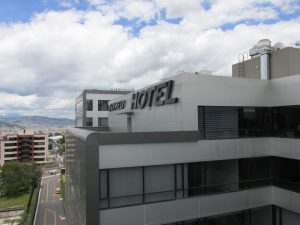
Sometimes we stay overnight in the hotel located next to the hospital which gives us an extra day for shopping and dining in Quito. The hotel is fantastic and costs around $100 a night. The problem is learning how to use the toilet which has a TV-like remote controller to serve every function you could imagine!


Now in defense of the US healthcare system, I have to say we are on Medicare which is like charity care for the doctors. Plus they have limited time to spend with each patient. Yes, there are great doctors in the US if they only had the time to practice their profession and provide care the way they would like to. They are always under the monitoring eyes of administrators, Press Gainey scores, and countless regulations.
In Ecuador, there are expert doctors but only available to those folks that are willing to pay as you go or are covered by Ecuadorian insurance. We did have government insurance, but you would need to go through the public healthcare system. So no immediate action would have been taken in Bill’s case. So for us, the “pay as you go” system was still less expensive than in the US. Later we found that the Austin ER visit and overnight stay in the hospital were around $7,000 and Medicare paid for all except $75.
So, in conclusion, there are great doctors in the US and Ecuador you just have to find them!
Please watch for my next blog that will update the past few months as we continue off the grid and loving life here in Ecuador
Texas Annie Ecuador